Picking up the phone to book a doctor’s appointment sounds simple. The harder part, for most Pakistani patients, is knowing which doctor to call in the first place. A wrong referral means wasted time, duplicate tests, and weeks of delay before you get an answer that actually helps. This confusion is especially common in cities like Lahore and Karachi, where private clinics outnumber public hospitals and every neighbourhood has a mix of general physicians, consultants, and specialists all practising within a few streets of each other. The fee for a specialist consultation in Pakistan typically ranges from PKR 1,000 to…
Author: Sameed Chaudhary
Most people in Pakistan assume a bad morning means they slept too little. They set an earlier alarm, drink an extra cup of chai, and push through. But tiredness that greets you the moment you open your eyes — even after seven or eight hours in bed — usually points to something deeper than hours counted. For many Pakistani adults, the pattern is familiar: late-night dinners, a phone in hand until midnight, load-shedding noise, or a ceiling fan that barely moves the summer heat. These aren’t minor inconveniences. They quietly wreck the quality of sleep even when the quantity looks…
The afternoon slump hits hard in Pakistan. Whether you’re a student in Lahore finishing a long morning of classes, an office worker in Karachi staring at a screen after lunch, or a shopkeeper in Rawalpindi who has been on his feet since Fajr, that post-zuhr heaviness is something most Pakistanis know well. What many don’t realise is that a short sleep of 20 minutes at this exact time is one of the most well-researched productivity tools in sleep science. It’s also a Sunnah. The Islamic practice of Qailula (قیلولہ), a brief midday rest, aligns remarkably closely with what modern researchers…
Most Pakistani households wind down the same way every night: chai finished, lights dimmed, and then an hour or two of scrolling through Instagram, watching YouTube, or catching up on WhatsApp. It feels like relaxing. For your brain, it’s the opposite. Research published in JAMA Network Open in 2025 found that people who used screens before bed had a 33% higher rate of poor sleep quality compared to those who avoided them. A study on university students in Pakistan, published in the International Journal of Psychology (2024), found that smartphone use before bedtime, particularly for social media, was directly linked…
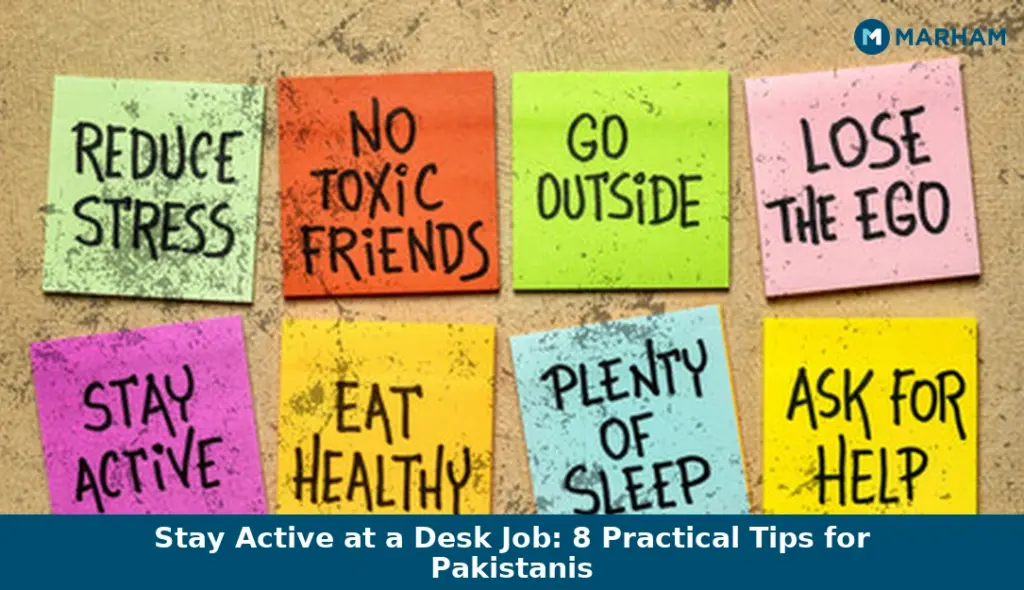
Most Pakistani office workers in Karachi and Lahore spend eight to ten hours a day at a desk, then another hour or two in a rickshaw or car on the commute home. That is a lot of sitting, and research now shows it carries real health consequences, separate from whether you exercise or not. A 2024 study published in the Journal of the American College of Cardiology found that sitting for more than 10.6 hours a day was linked to a higher risk of heart failure and cardiovascular death, even among people who met the standard exercise guidelines. That figure…
Most people in Pakistan decide to change their lifestyle after a health scare, a doctor’s warning, or a number on the scale that feels too high. The decision is easy. The follow-through is where almost everyone struggles. The problem is rarely motivation. Nutritionists in Pakistan see this constantly: patients arrive committed, try to change everything at once, and quit within two weeks. Research published in the European Journal of Social Psychology found that it takes anywhere from 18 to 254 days for a new behaviour to become automatic, with an average closer to 66 days. That gap between intention and…
You’ve been cutting back on roti, skipping chai biscuits, and walking every evening. The scale hasn’t moved in three weeks. Sound familiar? This is one of the most common frustrations Pakistani adults bring to nutritionists, and the answer is rarely as simple as “eat less, move more.” According to the Pakistan National Health Survey, over 40% of Pakistani adults are overweight or obese, with urban women aged 25 to 45 seeing the sharpest rise. Yet many of these same people are actively trying to lose weight and getting nowhere. The reasons are almost always specific and fixable — once you…
Most gym-goers in Pakistan spend hours planning their workout splits but give almost no thought to what goes on their plate before and after training. That gap quietly limits their results. Whether you train at a gym in Lahore, jog in DHA Karachi, or do home workouts in Rawalpindi, what you eat around your session shapes your energy, your recovery, and how much muscle you actually keep. The good news is that Pakistani food is genuinely well-suited for workout nutrition. Daal, anda, dahi, roti, chana, and chawal are not just comfort staples. They are carbohydrate and protein sources that sports…
Most Pakistanis track what they eat but rarely think twice about what they drink. A plate of biryani gets the blame. The three cups of doodh pati chai, the sweet lassi at lunch, and the chilled Rooh Afza at iftar quietly escape notice. This is the liquid calorie problem. Drinks deliver real energy to the body, but they don’t trigger the same feeling of fullness that solid food does. So you finish your chai, feel no different, and eat a full meal on top of it. The extra calories just stack up. According to WHO EMRO, Pakistanis consume far more…
Eating well doesn’t have to mean spending a lot. Some of the most nutritious foods available in Pakistan are also the most affordable, and they’ve been sitting in our kitchens for generations. The problem is that most people don’t realise how much nutritional value they’re already getting from everyday desi staples. Food prices have climbed sharply in recent years, but the cheapest items at any sabzi mandi in Lahore, Karachi, or Rawalpindi are still the ones nutritionists recommend most: lentils, eggs, leafy greens, and seasonal fruit. According to UNICEF Pakistan’s Cost of Diet report, a nutritious diet for a Pakistani…