
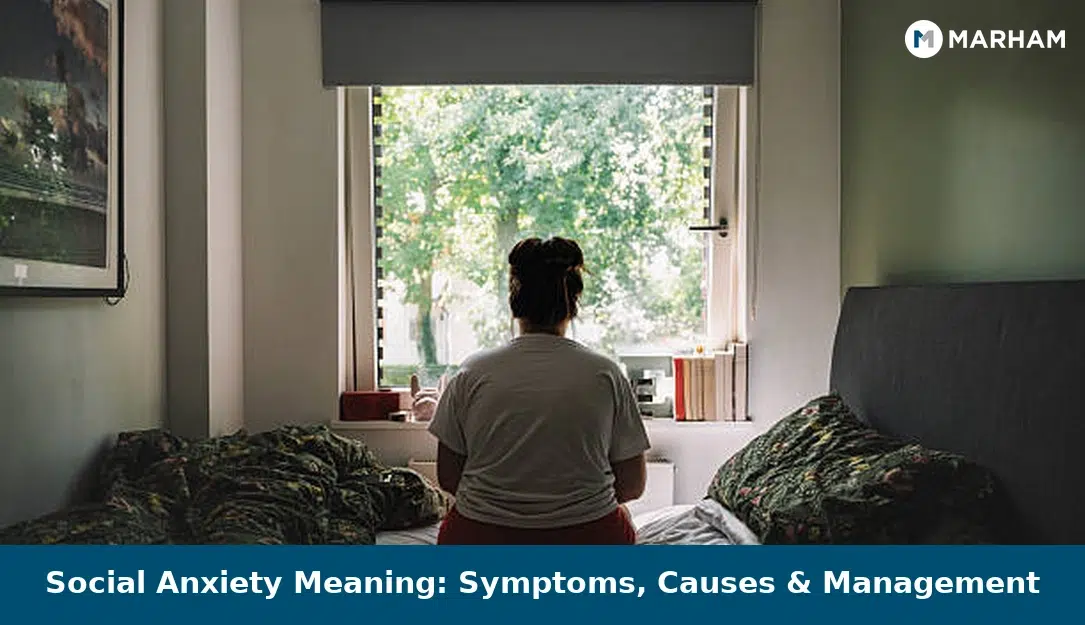
Many people in Pakistan feel a knot in the stomach before speaking in class, attending a family gathering, or walking into a room full of strangers. For most, that nervousness fades quickly. For some, it stays, grows, and starts shaping every decision they make about where to go and who to meet.
That persistent, overwhelming fear of being watched, judged, or embarrassed in social situations is what mental health professionals call social anxiety, known in Urdu as سماجی گھبراہٹ (samaji ghabrahat). It goes well beyond ordinary shyness. A systematic review published in PMC found an overall anxiety disorders prevalence of roughly 34% in Pakistan, with social and cultural pressures listed among the main contributing factors.
This guide explains what social anxiety actually means, how it differs from everyday nervousness, what its signs look like in daily Pakistani life, and what genuinely helps.
سماجی گھبراہٹ کا مطلب
سماجی گھبراہٹ ایک ذہنی صحت کی کیفیت ہے جس میں انسان کو سماجی حالات میں شدید خوف اور بے چینی محسوس ہوتی ہے۔ اس میں یہ ڈر ہوتا ہے کہ دوسرے لوگ ہمیں دیکھ رہے ہیں، ہمارا مذاق اڑا رہے ہیں یا ہمیں برا سمجھ رہے ہیں۔ پاکستان میں یہ مسئلہ خاص طور پر نوجوانوں میں عام ہے جہاں تعلیمی دباؤ، خاندانی توقعات اور سوشل میڈیا مل کر اس خوف کو بڑھاتے ہیں۔ بہت سے لوگ اسے صرف شرم یا کمزوری سمجھ کر نظرانداز کر دیتے ہیں، جبکہ یہ ایک قابلِ علاج حالت ہے جس کے لیے مناسب مدد لینا ضروری ہے۔
Social Anxiety Meaning: What It Actually Is
Social anxiety means an intense, persistent fear of social situations in which a person believes they may be negatively judged, embarrassed, or humiliated by others. It is not a character flaw or a sign of weakness.
The Anxiety and Depression Association of America (ADAA) describes it as a condition where the fear of being scrutinised is so strong that it interferes with daily life. This matters because the key word is interferes. Feeling nervous before a job interview is normal. Turning down the job entirely because you cannot face the interview panel, avoiding phone calls, skipping university lectures, or refusing family invitations for months at a time is social anxiety.
Psychiatrists distinguish between two forms. Specific social anxiety targets one type of situation, such as public speaking. Generalised social anxiety, which is far more common, causes fear across almost all social settings: eating in front of others, making eye contact, joining a group conversation, or even entering a shop alone.
For a deeper look at how social anxiety develops and how it is classified clinically, the social anxiety overview on Marham covers the full picture.

Social Anxiety Symptoms: What It Looks Like Day to Day
Social anxiety shows up in three overlapping ways: thoughts, physical sensations, and behaviours. Recognising all three is how you tell it apart from ordinary shyness.
Thought patterns common in social anxiety include:
- Constant worry before a social event, sometimes days in advance
- Replaying conversations afterward and focusing on what went wrong
- Assuming others noticed every mistake or awkward moment
- Believing you will say something foolish or embarrassing
Physical symptoms that appear in feared situations:
- Racing heartbeat or chest tightness
- Sweating, trembling, or a shaky voice
- Blushing, nausea, or an urge to leave immediately
- Dry mouth or difficulty forming words
Behavioural signs are often the most visible:
- Avoiding social events, gatherings, or group settings
- Staying silent in class or at work even when you know the answer
- Eating alone to avoid the canteen
- Rehearsing conversations extensively before making a simple phone call
In Pakistani universities and offices, social anxiety often looks like the student who never raises a hand despite knowing the material, or the employee who skips team lunches and avoids presentations at any cost. These are not personality quirks. They are patterns worth taking seriously.
Social Anxiety vs Shyness: A Key Difference
Shyness and social anxiety are not the same thing, though they are frequently confused in Pakistani households and even in some clinical settings.
Shyness is a temperament trait. A shy person may feel initial discomfort in new social settings but warms up over time and does not let that discomfort stop them from living their life. Social anxiety, by contrast, is a condition where the fear is disproportionate to the actual situation, does not ease with familiarity, and actively restricts what a person can do.

| Feature | Shyness | Social Anxiety |
|---|---|---|
| Intensity of fear | Mild to moderate | Intense, often overwhelming |
| Duration | Fades once settled in | Persists throughout the situation |
| Avoidance | Occasional | Regular, life-limiting |
| Physical symptoms | Rare | Common (palpitations, sweating) |
| Impact on daily life | Minimal | Significant (work, study, relationships) |
| Requires professional help | Usually not | Often yes |
The practical test: if the anxiety stops you from doing things you genuinely want or need to do, it has crossed from shyness into territory that deserves professional attention.
Causes of Social Anxiety: Why It Develops
No single cause explains social anxiety. It tends to develop from a combination of factors.
Genetics and brain chemistry play a role. People with a family history of anxiety disorders are more likely to develop social anxiety. The amygdala, the brain’s threat-detection centre, appears to be more reactive in people with social anxiety, triggering a fear response that is out of proportion to the actual situation.
Early experiences are a significant contributor. Bullying, harsh criticism, public embarrassment, or growing up in a highly critical environment can wire the brain to expect negative judgment in social settings. Research published in PMC notes that relationship difficulties and family conflict are positively associated with anxiety disorders in Pakistan.
Cultural and social pressures are particularly relevant for Pakistani readers. The expectation to perform academically, behave perfectly in front of relatives, speak fluently in English at school or at work, and maintain a certain image on social media all create conditions where fear of judgment can take root. Young people in cities like Lahore and Karachi, who navigate both traditional family expectations and modern social performance pressures simultaneously, face a specific kind of strain that can tip ordinary nervousness into social anxiety.
Social media adds another layer. Constant comparison with curated, idealised versions of others’ lives can deepen the belief that one does not measure up, a core fear in social anxiety.
How Social Anxiety Is Managed
Social anxiety is treatable. Most people who receive appropriate support see meaningful improvement. The two most evidence-based approaches are psychotherapy and, where clinically indicated, medication.
Cognitive Behavioural Therapy (CBT) is the most well-studied psychological treatment for social anxiety. CBT helps a person identify the distorted thought patterns that fuel the fear (for example, “everyone will notice I’m nervous”) and gradually replace them with more accurate, balanced thinking. It also involves gradual, structured exposure to feared situations, which reduces avoidance over time. According to clinical guidelines, CBT is considered a first-line treatment for social anxiety disorder.

Medication may be recommended in moderate to severe cases. Selective serotonin reuptake inhibitors (SSRIs), a class of antidepressant, are commonly prescribed. Any decision about medication should be made with a qualified psychiatrist after a proper assessment, not based on a blog or a friend’s advice.
Practical self-management strategies that support formal treatment include:
- Name the fear specifically. Write down exactly what you are afraid will happen in a given situation. Vague dread is harder to challenge than a specific thought.
- Use slow, controlled breathing. Inhale for four counts, hold for four, exhale for six. This activates the parasympathetic nervous system and reduces the physical symptoms of anxiety. Practice it at home before a feared situation.
- Gradually increase social exposure. Start with low-stakes situations: saying salam to a neighbour, asking a shopkeeper in your local bazaar a question, joining a small WhatsApp group conversation. Build up slowly.
- Limit social media comparison time. Set a daily limit on Instagram and similar apps. What you see online is a highlight reel, not reality. For Pakistani students especially, reducing this comparison habit can noticeably ease the background pressure.
- Challenge the post-event replay. After a social situation, the anxious mind tends to replay every awkward moment. When you catch yourself doing this, ask: “Would I judge a friend this harshly for the same thing?” Usually the answer is no.
- Maintain regular sleep and movement. Sleep deprivation worsens anxiety significantly. A 30-minute walk in a park, whether in DHA Lahore, Bagh-e-Jinnah Karachi, or a neighbourhood ground in Islamabad, can help regulate mood and reduce baseline anxiety.
- Talk to someone you trust. In Pakistani culture, mental health conversations within the family can feel difficult because of stigma. Starting with one trusted person, a close friend, a sibling, or a cousin, often makes the first step toward professional help easier.
When to See a Psychiatrist for Social Anxiety
Self-management strategies are useful, but they are not a substitute for professional care when the condition is significantly affecting your life.
Seek help from a mental health professional if social anxiety has been present for six months or longer, if it is causing you to avoid important situations at work, university, or in relationships, or if the physical symptoms are severe. A qualified psychiatrist in Pakistan can carry out a proper assessment, confirm the diagnosis, and guide you toward the right treatment, whether that is therapy, medication, or both. Early support tends to lead to better outcomes.
Speak to a Mental Health Specialist on Marham
For many people in Pakistan, the hardest part of managing social anxiety is taking the first step toward professional help. The stigma around mental health, the concern about what family might think, the uncertainty about where to go, all of these are real barriers.
Marham connects you with verified psychiatrists in Pakistan who offer online consultations from anywhere in the country, so you do not need to travel to a major city or sit in a waiting room. A short online consultation typically takes 15 to 20 minutes and gives you a clear starting point: whether what you are experiencing is social anxiety, what the appropriate next steps are, and whether therapy, medication, or a combination is likely to help. You can also connect with a psychologist or counsellor through Marham if you want to explore CBT specifically.
Frequently Asked Questions
What is the meaning of social anxiety?
Social anxiety means an intense, persistent fear of being judged or embarrassed in social situations. It goes beyond ordinary nervousness and can interfere with work, study, and relationships when left unaddressed.
Is social anxiety a mental illness?
Yes, social anxiety disorder is a recognised mental health condition listed in international diagnostic guidelines (DSM-5 and ICD-11). It is not a personality flaw or a sign of weakness, and it responds well to treatment.
How do I know if I have social anxiety?
If you regularly avoid social situations, feel intense fear or physical symptoms (racing heart, sweating) in social settings, and find that this pattern restricts your daily life, social anxiety may be the cause. A proper diagnosis requires evaluation by a qualified mental health professional.
What triggers social anxiety?
Common triggers include public speaking, meeting new people, eating in front of others, being the centre of attention, and situations where performance is evaluated. In Pakistan, academic pressure, family gatherings, and social media comparison are frequently reported triggers.
Can social anxiety be cured?
Social anxiety disorder is not typically described as “cured” but it can be effectively managed. Many people experience significant, lasting improvement with CBT and, where needed, medication. The goal is to reduce fear to a level where it no longer limits your life.
What is the difference between social anxiety and shyness?
Shyness is a temperament trait that causes mild discomfort in new situations and fades with time. Social anxiety is a clinical condition where the fear is disproportionate, does not ease with familiarity, causes physical symptoms, and actively limits what a person can do.
When should I see a doctor for social anxiety?
See a mental health professional if social anxiety has lasted six months or more, is causing you to avoid important situations, or is significantly affecting your quality of life. Early professional support leads to better outcomes.
Conclusion
Social anxiety meaning, at its core, is a persistent and disproportionate fear of social judgment that goes well beyond ordinary shyness. It is common, it is real, and it is manageable with the right support. Recognising the symptoms in yourself or someone close to you is the most important first step. The next is knowing that effective help, through therapy, medication, or both, exists and is accessible in Pakistan.