
Obsessive-compulsive disorder is one of those conditions that gets talked about casually in Pakistan — “woh toh bohot OCD hai” — but rarely taken seriously as a medical diagnosis. Most people who live with it spend years assuming they are just overly careful, overly religious, or overly anxious, without realising there is a name for what they experience and, more importantly, a treatment that works.
According to the World Health Organization (2022), OCD affects roughly 1 to 3 percent of the global population at some point in their lives. In Pakistan, the picture is complicated by two things: a strong cultural tendency to frame intrusive thoughts as waswas (شیطانی وسوسے) rather than a medical condition, and a mental health system where psychiatrists are concentrated in Lahore, Karachi, and Islamabad, leaving patients in smaller cities with very limited options.
This guide covers what OCD actually looks like in Pakistani daily life, the five main types, how it differs from ordinary anxiety, and what getting help realistically involves.
What Is OCD, Exactly?
OCD (obsessive-compulsive disorder) is a mental health condition in which a person experiences persistent, unwanted thoughts called obsessions, and feels driven to perform repetitive actions called compulsions to reduce the distress those thoughts cause. The compulsions bring temporary relief but reinforce the cycle, making the obsessions return stronger. According to the American Psychiatric Association’s DSM-5 criteria (2013, updated 2022), OCD is diagnosed when obsessions and compulsions consume more than one hour per day and cause meaningful interference with daily functioning.
What Are the Signs of OCD in Pakistan?
OCD signs fall into two categories: obsessions and compulsions. Both must be present for a clinical diagnosis, though one may dominate.
Obsessions are unwanted, intrusive thoughts, images, or urges that cause distress. Common ones in Pakistani patients include:

- Fear of contamination from touching shared surfaces (door handles, public transport rails)
- Repeated doubt about whether a task was done correctly (gas off, door locked, wudu valid)
- Intrusive thoughts about harming a loved one, even though the person has no desire to do so
- Blasphemous or sexual thoughts that feel deeply shameful and out of character
- A need for things to be arranged in a precise, symmetrical way
Compulsions are the repetitive behaviours or mental acts performed to neutralise the obsession’s distress:
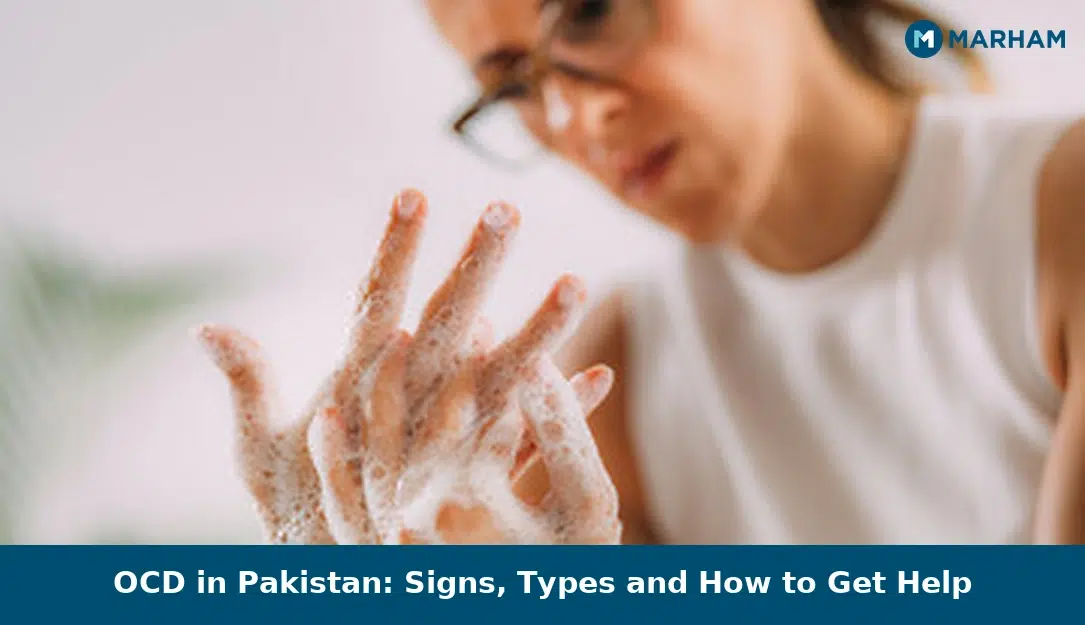
- Washing hands until the skin cracks, often 20 to 50 times a day
- Checking locks, switches, or the stove repeatedly before leaving home
- Repeating wudu or salah because it didn’t feel “complete”
- Counting, tapping, or arranging objects in a specific sequence
- Seeking constant reassurance from family members
A key clinical point: people with OCD usually know their fears are irrational. That awareness doesn’t stop the compulsion. This is what separates OCD from psychosis, where the person believes the fear is real.
5 Types of OCD Common in Pakistan
OCD is not one uniform condition. Psychiatrists in Pakistan see several distinct presentations, and knowing which type applies matters for treatment.
| Type | Core Obsession | Typical Compulsion |
|---|---|---|
| Contamination OCD | Fear of germs, dirt, or illness | Excessive handwashing, avoiding shared objects |
| Checking OCD | Doubt that something was done or done safely | Repeated checking of locks, appliances, messages |
| Religious OCD (Waswas) | Fear that worship was invalid or sinful | Repeating wudu, salah, or Quran recitation |
| Harm OCD | Intrusive thoughts of hurting self or others | Avoidance, mental reviewing, seeking reassurance |
| Symmetry OCD | Discomfort when things are uneven or “wrong” | Arranging, ordering, repeating actions until “right” |
Religious OCD (Waswas al-Qahri): A Distinctly Pakistani Challenge
Religious OCD, known in Islamic scholarship as waswas al-qahri, is one of the most common and most misunderstood presentations in Pakistan. A person may repeat wudu five or ten times because it never feels “properly done”, or spend hours reciting a single verse because a stray thought interrupted the recitation. Family members often encourage the repetition, believing it shows piety. Imams may advise more dhikr. Neither response helps, and both can worsen the cycle.
Clinical research published in the journal Transcultural Psychiatry (2020) confirms that religious OCD in Muslim populations responds to the same evidence-based treatment as other OCD types: Exposure and Response Prevention (ERP) therapy. The compulsion is the repetition, not the prayer itself, and treatment targets the compulsion. Seeking professional help for waswas al-qahri is not a sign of weak faith. It is a medically appropriate response to a recognised brain-based condition.

Harm OCD: The Most Stigmatised Type
Harm OCD deserves special mention because it causes enormous shame in Pakistani families. A mother may have intrusive thoughts about harming her newborn. A young man may have violent images involving a family member. These thoughts are ego-dystonic, meaning they are completely contrary to the person’s values and deeply distressing. They do not indicate intent or danger. Psychiatrists and clinical psychologists in Pakistan see this presentation regularly, and it responds well to ERP therapy combined with psychoeducation for the family.
OCD vs Anxiety: Key Differences
OCD is classified separately from generalised anxiety disorder (GAD), though the two often co-occur. The table below shows the practical differences a Pakistani reader might notice.
| Feature | OCD | Generalised Anxiety |
|---|---|---|
| Thought type | Specific, intrusive, repetitive | Broad, diffuse worry about life events |
| Compulsions present | Yes, always | No |
| Insight | Person knows thoughts are irrational | Person may believe worries are realistic |
| Relief pattern | Brief relief after compulsion, then return | Worry fluctuates without a ritual cycle |
| First-line treatment | ERP therapy + SSRIs | CBT + SSRIs or SNRIs |
If you’re unsure whether what you experience is OCD or anxiety, a psychiatrist in Pakistan can assess both conditions in a single consultation.
What Causes OCD?
No single cause has been identified. Research points to a combination of factors:
- Neurological: Brain imaging studies show differences in the orbitofrontal cortex and striatum in people with OCD, areas involved in error-detection and habit formation.
- Genetic: Having a first-degree relative with OCD raises the risk, though the condition can appear with no family history.
- Environmental: High-stress periods (university exams, new marriage, childbirth, bereavement) can trigger or worsen symptoms in people who are already predisposed.
- Learned behaviour: When a compulsion relieves anxiety even once, the brain learns to repeat it. Over time the threshold lowers and the compulsion becomes harder to resist.
OCD is not caused by weak willpower, poor upbringing, or spiritual failure. It is a recognised medical condition with a well-understood mechanism.
How Is OCD Treated in Pakistan?
OCD cannot be cured in the way an infection is cured, but it can be managed effectively. Most patients who receive proper treatment see a meaningful reduction in symptoms. The two evidence-based approaches, used together or separately depending on severity, are:
- Exposure and Response Prevention (ERP) therapy: A structured form of cognitive behavioural therapy (CBT) in which the patient gradually faces the feared situation without performing the compulsion. For example, a person with contamination OCD touches a door handle and waits without washing. The anxiety peaks and then falls on its own. Repeated exposure teaches the brain that the feared outcome does not occur. ERP is considered the gold-standard psychological treatment for OCD by the American Psychological Association (2023).
- Medication (SSRIs): Selective serotonin reuptake inhibitors, a class of antidepressant medication, are the first-line pharmacological treatment for OCD. They are prescribed by a psychiatrist, not a general physician, because the doses used for OCD are typically higher than those used for depression and require careful monitoring. A psychiatrist will decide whether medication is appropriate based on symptom severity.
- Psychoeducation for the family: In Pakistani households, family members often accommodate OCD without realising it — answering reassurance questions, allowing extra washing time, or joining rituals. Family accommodation maintains the OCD cycle. A clinical psychologist can work with the family to reduce accommodation gradually and safely.
- Online therapy: For patients in cities outside Lahore, Karachi, and Islamabad, online sessions with a trained psychologist or psychiatrist are a practical option. Sessions are typically 45 to 60 minutes and can be conducted over video call.
- Realistic timeline: Most patients notice improvement within 12 to 16 weeks of consistent ERP therapy. Medication may take 8 to 12 weeks to show full effect. OCD management is ongoing; the goal is to reduce symptoms to a level where they no longer dominate daily life.
When Should You See a Specialist?
Seek professional help when OCD symptoms consume more than an hour of your day, cause you to avoid work, studies, or social situations, or create significant distress for you or your family. Waiting rarely helps. OCD tends to expand into new areas over time if left untreated, and the longer the compulsion cycle runs, the more entrenched it becomes.
A psychiatrist in Pakistan can confirm the diagnosis, rule out other conditions such as depression, and recommend whether therapy, medication, or both are appropriate for your situation. If you’ve been managing what feels like waswas for years without improvement, a psychiatric evaluation is a reasonable and medically sound next step.
Key Takeaways
- OCD in Pakistan affects roughly 1 to 3 percent of the population, according to the World Health Organization (2022), and is frequently misidentified as a personality trait or spiritual problem.
- OCD requires both obsessions (unwanted intrusive thoughts) and compulsions (repetitive acts to reduce distress) for a clinical diagnosis under DSM-5 criteria.
- Religious OCD, known as waswas al-qahri, is a recognised clinical presentation in Muslim populations and responds to the same ERP therapy used for other OCD types.
- Harm OCD involves intrusive thoughts about hurting others; these thoughts are ego-dystonic and do not indicate intent or danger.
- Exposure and Response Prevention (ERP) therapy is the gold-standard psychological treatment for OCD, according to the American Psychological Association (2023).
- OCD cannot be cured but can be managed effectively; most patients see meaningful improvement within 12 to 16 weeks of consistent ERP therapy.
Speak to a Psychiatrist on Marham
Finding a psychiatrist who understands OCD, and specifically its religious presentations, can feel difficult in Pakistan. Many families spend months going between general physicians, religious scholars, and counsellors before reaching someone with the right training. Marham connects you with over 16,000 PMC-verified doctors, including psychiatrists in Pakistan who consult online from Lahore, Karachi, Islamabad, and 155 cities across the country. An online consultation starts from Rs 500, so geography and cost don’t have to be the reason treatment gets delayed.
A first psychiatric consultation for OCD typically involves a structured interview about the nature, frequency, and duration of your thoughts and rituals. The psychiatrist may use a standardised tool called the Yale-Brown Obsessive Compulsive Scale (Y-BOCS) to assess severity. From there, they’ll recommend whether ERP therapy, medication, or a combination is the right starting point. You can also access a free GP online consultation at Marham free consultation if you want a first opinion before booking a specialist.
Frequently Asked Questions
Is OCD a mental illness or just a habit?
OCD is a recognised mental health condition, not a habit or personality trait. It involves measurable differences in brain activity and responds to specific clinical treatments. Calling it “just a habit” delays the help that actually works.
Can OCD be cured completely?
OCD cannot be cured in the way an infection is, but it can be managed very effectively. Most people who complete a course of ERP therapy and, where needed, medication, reduce their symptoms to a level where OCD no longer controls their daily life.
What is the difference between OCD and waswas in Islam?
Waswas refers to whispered doubts from Shaytan, a concept in Islamic theology. Waswas al-qahri is the clinical term for OCD that manifests through religious rituals. The two can overlap, but OCD is a medical condition requiring professional treatment, not only spiritual practice.
Can OCD go away on its own without treatment?
OCD rarely resolves on its own. Without treatment, symptoms tend to persist and often expand into new areas over time. Early professional intervention generally leads to better outcomes.
What triggers OCD episodes?
Common triggers include high-stress life events such as exams, marriage, childbirth, or bereavement, as well as fatigue and disrupted sleep. Triggers vary by person and by OCD type.
Is OCD related to depression or anxiety?
OCD frequently co-occurs with depression and anxiety. According to the American Psychiatric Association (2022), roughly 25 to 50 percent of people with OCD also experience a depressive episode at some point. A psychiatrist can assess and treat co-occurring conditions together.
When should I see a psychiatrist for OCD rather than a psychologist?
See a psychiatrist if your symptoms are severe, if you’ve already tried therapy without improvement, or if you want an assessment for medication. A psychologist is appropriate for ERP therapy. Many patients benefit from working with both.
OCD in Urdu
اوسی ڈی (OCD) یا وسواسی مجبوری کی خرابی ایک طبی حالت ہے جس میں انسان کے ذہن میں بار بار ناپسندیدہ خیالات آتے ہیں اور انہیں دور کرنے کے لیے وہ بار بار ایک ہی کام کرتا رہتا ہے۔ پاکستان میں اسے اکثر وسوسے یا ذاتی عادت سمجھ کر نظرانداز کر دیا جاتا ہے، جبکہ یہ ایک قابلِ علاج دماغی بیماری ہے۔ اس کا سب سے مؤثر علاج ایکسپوژر اینڈ رسپانس پریوینشن (ERP) تھراپی اور ضرورت پڑنے پر دوائیں ہیں۔ اگر آپ یا آپ کے گھر میں کوئی بار بار وضو کرتا ہو، تالے چیک کرتا ہو، یا ذہن میں آنے والے خیالات سے پریشان ہو، تو کسی ماہرِ نفسیات سے ملنا ضروری ہے۔
Conclusion
OCD in Pakistan sits at an uncomfortable intersection of medical reality and cultural misunderstanding. People live with it for years, sometimes decades, before anyone names it correctly. The condition is real, the distress is real, and the treatments work. Whether the presentation is contamination, checking, harm, symmetry, or religious OCD, the path forward is the same: an accurate diagnosis from a trained professional, followed by structured therapy and, where appropriate, medication. Getting that assessment is the hardest step for most Pakistani families. It’s also the most important one.