

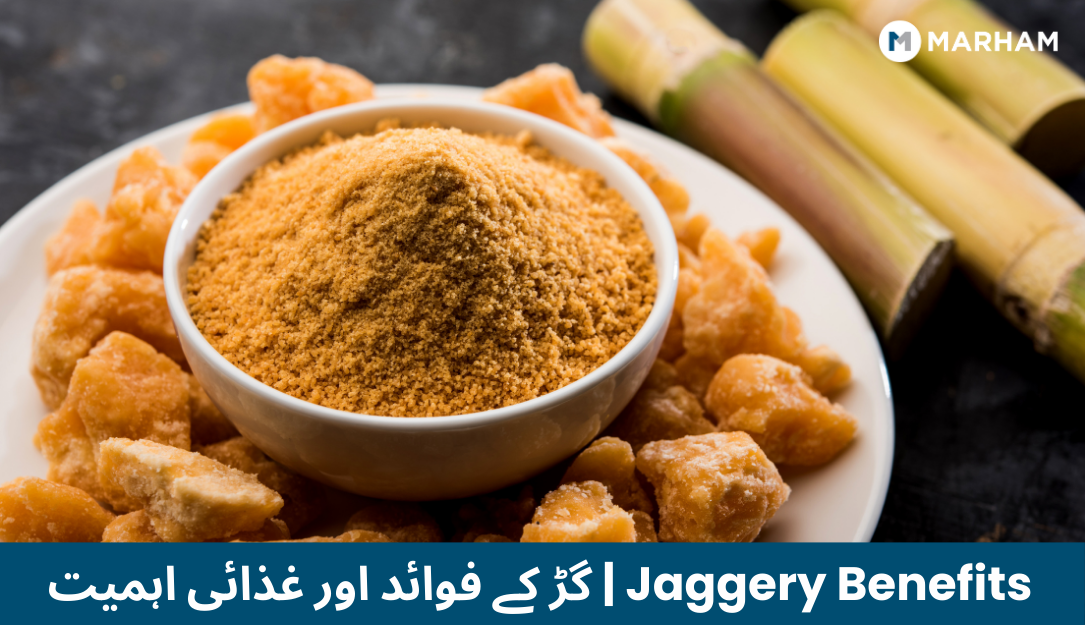
Your grandmother probably ended meals with a small piece of gur. She believed it helped digestion. But does jaggery actually offer health benefits, or is it just sugar with a better reputation? Here is what research says about jaggery benefits.
What is Jaggery?
Jaggery (gur in Urdu/Hindi) is an unrefined sweetener made by boiling sugarcane juice or palm sap until it solidifies. Unlike white sugar, jaggery retains molasses during processing, which preserves certain minerals. This is why jaggery has a golden-brown color and earthy taste.
India produces about 36% of its sugarcane crop as jaggery. This makes it one of the largest producers worldwide.
Jaggery Nutrition Facts (Per 100 g)
According to ScienceDirect research, 100 grams of jaggery contains:
| Nutrient | Amount | % Daily Value |
| Calories | 383 kcal | — |
| Carbohydrates | 97g | — |
| Sucrose | 65-85 g | — |
| Iron | 10-13 mg | 55-72% |
| Potassium | 1050 mg | 30% |
| Magnesium | 70-90 mg | 20% |
| Calcium | 40-100 mg | 4-10% |
| Phosphorus | 20-90 mg | 3-13% |
Important context: A realistic serving is 1 tablespoon (20 g), not 100 g. One tablespoon provides roughly 77 calories and 2.2 mg iron (12% daily value).
Jaggery Benefits Backed by Research

Iron Content May Help Prevent Anemia
Among jaggery benefits, iron content stands out. One tablespoon provides about 12% of your daily iron needs.
A 2018 study published in the National Journal of Physiology, Pharmacy and Pharmacology tested jaggery and raisins on 50 female medical students with iron deficiency anemia. After 8 weeks of daily consumption, hemoglobin levels increased by 4.1%.
A 2024 randomized controlled trial at JIPMER, Puducherry, found that sesame-jaggery balls (60 g each) used alongside iron syrup helped improve hemoglobin in children aged 6-11 years with moderate anemia.
However, jaggery alone cannot cure anemia. It works best as part of a balanced diet alongside other iron-rich foods like spinach, lentils, and meat.
Contains Minerals That White Sugar Lacks
White sugar provides “empty calories”. This is energy without nutrients. Jaggery retains trace minerals from sugarcane processing.
Per 100 g, jaggery offers:
- 30% daily potassium (supports blood pressure regulation)
- 20% daily magnesium (supports muscle and nerve function)
- Trace amounts of zinc, copper, and manganese
These minerals make jaggery a marginally better choice than refined sugar for people without blood sugar concerns.
Traditional Digestive Aid
In South Asian households, eating a small piece of jaggery after meals is believed to aid digestion. Although no clinical trials confirm this specific practice, jaggery’s mineral content (particularly potassium) may help maintain electrolyte balance.
Some practitioners suggest that unrefined sugars stimulate digestive enzyme secretion. However, this claim needs more rigorous scientific study.
Quick Energy Source
Athletes and laborers have traditionally used jaggery for quick energy. With 383 calories and 97 g carbohydrates per 100 g, jaggery provides rapid fuel for physical activity.
Unlike complex carbohydrates that release energy slowly, jaggery’s simple sugars absorb quickly into the bloodstream. This makes it useful for immediate energy needs but problematic for sustained energy or blood sugar management.
How Jaggery Affects Your Glucose Levels
Here is where jaggery benefits come with a serious caveat.
A study from Madras Medical College measured jaggery’s glycemic index (GI) at 84.4. For comparison, white sugar has a GI of approximately 65.
This means jaggery raises blood sugar faster and higher than white sugar.
The misconception that jaggery is “safe for diabetics” is scientifically false.
According to a 2024 review published in Magna Scientia Advanced Research and Reviews, jaggery’s high GI poses significant risks for people with diabetes or metabolic syndrome.
Who Should Avoid Jaggery?

Diabetics:
With a GI of 84.4, jaggery causes rapid blood sugar spikes. It is not a suitable sugar substitute for diabetes management.
People watching weight:
Jaggery has the same caloric density as white sugar (383 kcal/100g). It does not help with weight loss.
Those with poor blood sugar control:
Even non-diabetics with insulin resistance should limit jaggery consumption.
Jaggery vs. White Sugar: Which Should You Choose?
| Factor | Jaggery | White Sugar |
| Calories (100 g) | 383 | 387 |
| Iron | 10 – 13 mg | 0 mg |
| Potassium | 1050 mg | 2 mg |
| Glycemic Index | 84.4 | 65 |
| Processing | Minimal | Highly refined |
Verdict: Jaggery is nutritionally superior to white sugar due to its mineral content. However, it raises blood sugar faster. Neither should be consumed excessively.
How to Use Jaggery Safely
Recommended amount:
Take 10-20 grams daily (about 1 tablespoon) for healthy adults.
Best uses:
- Sweetening tea or milk.
- Making traditional desserts like gur ka halwa or til ladoo.
- Adding to warm water with lemon in winter.
Storage:
Keep in an airtight container in a cool, dry place. Jaggery absorbs moisture quickly.
Frequently Asked Questions About Jaggery Benefits
Is jaggery better than honey?
Both have similar calories. Honey has a slightly lower GI (around 58) than jaggery (84.4). For blood sugar management, honey is the better choice. For iron content, jaggery wins.
Can I eat jaggery daily?
Yes, you can eat jaggery daily if you’re healthy. It offers several jaggery benefits when consumed in moderation, around 10–20 grams per day. However, people with diabetes or weight concerns should avoid regular consumption.
Does jaggery detox the liver?
No scientific evidence supports this claim. Your liver detoxifies naturally without special foods.
Is palm jaggery better than cane jaggery?
Palm jaggery may have a slightly lower glycemic index than cane jaggery, though research is limited. Both should be consumed in moderation.
The Bottom Line on Jaggery Benefits
Jaggery offers genuine nutritional advantages over white sugar, particularly its iron, potassium, and magnesium content. Studies show it can contribute to improved hemoglobin levels when combined with other iron-rich foods.
However, jaggery remains a form of sugar. Its high glycemic index (84.4) makes it unsuitable for diabetics and people managing blood sugar. The mineral benefits do not justify unlimited consumption.
Use jaggery as a better alternative to white sugar, not as a health food. A small piece after meals or in your chai is fine for healthy individuals. But if you have diabetes, prediabetes, or weight concerns, speak with your doctor first.
For personalized dietary advice based on your health conditions, consult a nutritionist at Marham. Call 0311-1222398 to book your online or physical appointment today!