

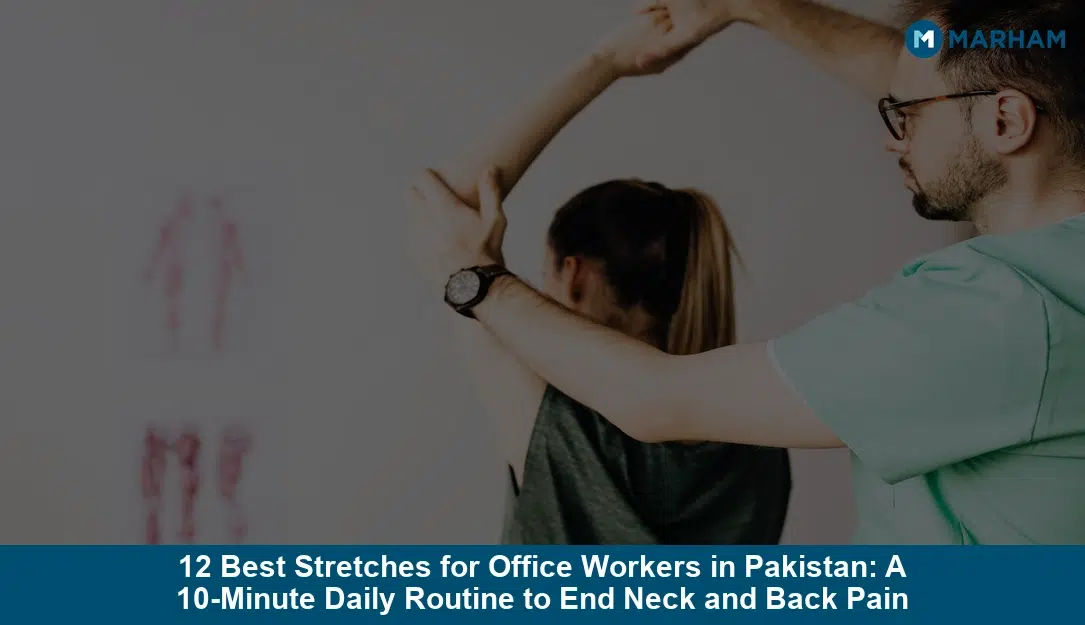
If you work in an office in Karachi, Lahore, or Islamabad — or anywhere else in Pakistan — and spend 8 to 10 hours hunched over a laptop, you already know the pain. Your neck is stiff by Zuhr. Your shoulders feel like cement by 4 PM. Your lower back screams when you finally stand up. By the time you are stuck in evening traffic on Ferozepur Road or Shahrah-e-Faisal, the headache has set in. This is not just discomfort — it is one of the most preventable health issues facing Pakistani office workers and freelancers today. The good news is that you can fix most of it with a 10-minute stretching routine done at your desk, with no gym membership and no special equipment required.
According to peer-reviewed research published in Physical Therapy (Oxford), neck pain from computer work affects 50 to 70 percent of office workers globally, and workplace stretching interventions of just 5 to 10 minutes daily significantly reduce neck and shoulder pain intensity [Source: Physical Therapy, Oxford Academic, 2018].
Why Pakistani Office Workers Suffer More From Desk Pain
Pakistani office workers are at higher risk than many of their global counterparts for several reasons. Working hours tend to be longer — 9 to 10 hour shifts are common in banks, IT firms, and call centres. Ergonomic furniture is rare, with most desks, chairs, and monitors not adjustable. Laptops dominate over desktop setups, which forces workers to slouch forward to read screens. Lunch breaks at the desk are routine, eliminating midday movement. Commutes of 1 to 2 hours in traffic add to the daily sitting load. And there is a cultural reluctance to stretch openly, as many workers feel awkward doing it in front of colleagues.
The result is a predictable pattern called desk posture: rounded shoulders, forward head, tight chest muscles, weak upper back, tight hip flexors, and a stiff lower back. Over months and years, this creates chronic pain patterns that affect sleep, mood, and quality of life.
What Research Says About Office Stretching
A meta-analysis of 23 studies covering 3,000 office workers found that ergonomic exercises significantly reduce neck and shoulder pain intensity. The most effective protocols share three features: they prioritise frequency over duration, with short daily sessions of 5 to 10 minutes outperforming single weekly sessions; they combine stretching with strengthening, because stretching alone gives only temporary relief; and they pair exercise with ergonomic fixes like monitor height and chair adjustments. Stretching alone reduces pain by around 20 to 30 percent in symptomatic office workers. Combined with strengthening and ergonomic changes, that improvement can reach 60 to 80 percent [Source: BMJ Open, 2022].
The 10-Minute Daily Desk Stretch Routine
This routine targets all the major problem areas in order — neck, shoulders, upper back, lower back, hips, and wrists. Each stretch takes about 30 to 60 seconds. Total time is 10 minutes. The full routine should be done once in the morning, once midday, and one short version (the first 6 stretches) every 60 to 90 minutes during work.
1. Chin Tuck
The chin tuck corrects forward head posture, which is the single biggest cause of neck pain in desk workers. For every inch your head juts forward, your neck muscles work significantly harder to support its weight. Sit upright with shoulders relaxed. Without tilting your head up or down, slowly draw your chin straight back as if making a double chin. Hold for 5 seconds, relax, and repeat 10 times. Do this 2 to 3 times throughout the day, especially after long meetings.
2. Upper Trapezius Stretch (Neck Side Stretch)
The upper trapezius is the most chronically tight muscle in office workers. It runs from the neck to the shoulder and locks up from screen time and stress. Sit tall with shoulders relaxed. Slowly tilt your head so your right ear moves toward your right shoulder. Place your right hand gently on the left side of your head and apply very light pressure — never pull forcefully. Feel the stretch on the left side of your neck. Hold for 30 seconds, then switch sides. Repeat 2 to 3 times per side, twice daily.
3. Neck Rotation Stretch
This stretch restores side-to-side movement that gets restricted from staring straight at a screen for hours. Sit tall with shoulders down. Slowly turn your head to the right as far as comfortable and hold for 15 to 20 seconds. Return to centre, then turn to the left and hold for another 15 to 20 seconds. Avoid full neck circles or rolls — research shows they put too much stress on the cervical spine and can compress the arteries in your neck.

4. Shoulder Rolls
Shoulder rolls release the tension that builds up in the trapezius and rhomboid muscles from typing and mouse use. Sit or stand tall. Lift both shoulders up toward your ears, then roll them back and down in a smooth circular motion. Repeat 10 rolls backward, then 10 rolls forward. Do this every 60 to 90 minutes — it is the easiest stretch to perform discreetly in an open office.
5. Seated Cat-Cow
The seated cat-cow mobilises your entire spine, especially the mid-back area that gets stiff from sitting. Sit on the edge of your chair with feet flat on the floor. Place your hands on your knees. For cow pose, inhale and arch your back, pushing your chest forward and looking slightly upward. For cat pose, exhale and round your back, tucking your chin and pulling your belly button toward your spine. Repeat 8 to 10 times slowly, syncing each movement with your breath.
6. Seated Spinal Twist
This stretch releases tension in the lower back and improves spinal rotation that is lost from staying static at a desk. Sit tall with feet flat on the floor. Place your right hand on the outside of your left thigh and your left hand on the back of your chair. Gently twist your torso to the left, looking over your left shoulder. Hold for 20 to 30 seconds, then switch sides.
7. Doorway Chest Stretch
Tight chest muscles pull your shoulders forward, causing rounded posture and neck pain. Most office workers ignore this stretch, but it is one of the most important. Stand in a doorway. Place your right forearm against the door frame with your elbow at shoulder height, forming a 90-degree angle. Step forward through the doorway with your right foot until you feel a stretch across your chest and the front of your shoulder. Hold for 30 to 60 seconds, then switch sides. Do this twice daily — once in the morning and once before leaving the office.
8. Standing Forward Fold
The standing forward fold decompresses the lower back and stretches tight hamstrings — both major pain sources for desk workers. Stand with feet hip-width apart. Hinge forward at the hips, letting your upper body hang down. Bend your knees as much as needed — do not force straight legs. Let your head and arms hang heavy. Hold for 30 to 60 seconds, then slowly roll up, one vertebra at a time.
9. Hip Flexor Lunge
Sitting for hours shortens your hip flexors, which pull your lower back into pain when you stand. This stretch is non-negotiable for anyone with desk-job back pain. Step your right foot forward into a lunge position. Lower your left knee toward the floor, using a folded towel under the knee for comfort. Keep your back upright. Push your hips slightly forward until you feel a stretch in the front of your left hip. Hold for 30 to 60 seconds, then switch sides. Do this once daily, ideally during your lunch break or at home.
10. Wall Angels
Wall angels strengthen the upper back muscles that get weak from sitting and improve shoulder posture. This is a posture corrector, not just a stretch. Stand with your back against a wall, feet about 6 inches forward. Press your lower back, upper back, and the back of your head against the wall. Raise your arms to shoulder height with elbows bent 90 degrees, keeping the backs of your hands against the wall. Slowly slide your arms upward overhead while maintaining wall contact, then return to the starting position. Repeat 10 times. Most desk workers cannot maintain full wall contact at first — this is normal and improves with practice.
11. Wrist Flexor and Extensor Stretch
Typing and mouse use create cumulative strain on the wrist tendons. Left untreated, this can lead to carpal tunnel syndrome, a common condition among Pakistani IT workers, accountants, and writers. For the wrist flexor stretch, extend your right arm forward with palm up. With your left hand, gently pull your right fingers down and back toward your body. Hold for 20 to 30 seconds and switch sides. For the wrist extensor stretch, extend your right arm forward with palm down. With your left hand, gently push the back of your right hand down and toward your body. Hold for 20 to 30 seconds and switch sides.

12. Diaphragmatic Breathing
Office workers tend to take shallow chest breaths, which overwork the neck muscles. Deep belly breathing relaxes the entire shoulder-neck region and reduces stress. Sit upright or stand. Place one hand on your chest and one hand on your belly. Inhale slowly through your nose for 4 seconds, letting your belly expand — your chest hand should barely move. Exhale slowly through your mouth for 6 seconds. Repeat for 5 to 10 breaths. Do this hourly during stressful work periods — it is the single most underused tool for desk-job neck pain.
Ergonomic Setup Fixes You Cannot Skip
Stretching helps, but you cannot stretch your way out of bad ergonomics. The top of your monitor should be at or slightly below eye level, at an arm’s length (50 to 70 cm) from your face. If you use a laptop, invest in a laptop stand and an external keyboard — a setup available for PKR 2,500 to 5,000 that pays off in prevented doctor visits.
Your chair should allow your feet to rest flat on the floor (use a footrest if needed), with knees at roughly 90 degrees and lower back supported by lumbar cushion if the chair lacks it. Your elbows should be at 90 to 110 degrees when typing, wrists straight (not bent up or down), and mouse close to the keyboard so you are not reaching. Avoid screen glare from windows, use a desk lamp if office lighting is poor, and follow the 20-20-20 rule for eye strain: every 20 minutes, look at something 20 feet away for 20 seconds.
Movement Habits That Beat Desk Pain
Stretches and ergonomics are not enough on their own — you need movement built into your day. Stand up every 60 minutes, even for just 60 seconds. Walk during phone calls. Take the stairs whenever possible, even for 1 or 2 floors. After lunch, walk for 10 minutes outside — but avoid 11 AM to 4 PM during Pakistani summer. Pray on time; the movements of namaz force regular stretching, especially during prostration (sajda). Two or three times a week, add 30 minutes of strengthening exercise like planks, push-ups, squats, walking, gym, or swimming.
Strengthening your back, core, and shoulder muscles is the long-term cure. Stretching provides daily relief but does not build the muscular support your spine needs.
Work-From-Home Pain Is Often Worse
Working from home in Pakistan often produces worse posture than the office — couch laptop use, working from bed, and no proper desk are all too common. If you work from home, set up a dedicated workspace even if it is just a corner of a room. Use a real chair, not a sofa or bed. Get a laptop stand. Wake up and start work at the same times you would in an office. Set a phone alarm every 90 minutes to stand and stretch. Do not eat lunch at your makeshift desk — eat at the dining table to force movement.
When to See a Doctor
Most desk-job pain is musculoskeletal and resolves with stretching, ergonomics, and movement within 4 to 6 weeks. But you should see a doctor if you experience pain that does not improve after 2 to 4 weeks of consistent stretching and movement breaks. Numbness, tingling, or weakness in your arms, hands, or fingers may indicate a pinched nerve or carpal tunnel syndrome. Sharp shooting pain down your arm or leg may indicate a disc issue. Headaches more than 3 times a week could be cervicogenic (neck-related). Pain that wakes you up at night is a red flag. Loss of bladder or bowel control combined with back pain is a medical emergency — go to ER immediately. Pain after a fall, accident, or sudden injury should be assessed promptly.
A general physician can do an initial assessment and refer you to the right specialist. For spine, joint, and musculoskeletal evaluation, see an orthopedic surgeon. For nerve-related symptoms like numbness, tingling, or weakness, see a neurologist. For hands-on treatment, customised exercise plans, and manual therapy, see a physiotherapist. For widespread joint pain with signs of arthritis, see a rheumatologist.
Frequently Asked Questions
How long should I stretch every day if I work in an office?
Aim for 10 minutes total, split between morning, midday, and evening. Short frequent sessions work better than one long session.
Will stretching alone fix my neck and back pain?
For mild pain, often yes. For chronic pain, you also need ergonomic fixes, movement breaks, and strengthening exercises. If pain persists beyond 4 weeks, see a doctor.
Are neck rolls or full circles safe?
No. Research shows neck rolls can compress arteries and stress the cervical spine. Stick to side stretches, rotations, and chin tucks instead.
I work from home — does that change anything?
Yes. Work-from-home setups are usually worse for posture because people use couches, beds, or low laptops. You need stronger ergonomic discipline at home: a real desk, a real chair, and a laptop stand are essential.
Should I get a standing desk?
Standing desks help by changing position, but standing all day creates its own problems like foot, leg, and lower back fatigue. The best approach is variety: sit, stand, and move in rotation throughout the day.
Which doctor should I see for desk-job back pain?
Start with a general physician or orthopedic surgeon. If you have numbness, tingling, or weakness in your arms or legs, see a neurologist. For hands-on treatment, a physiotherapist is often the most effective first stop.
Can a chiropractor help with office worker pain?
Chiropractic care is uncommon and inconsistently regulated in Pakistan. A qualified physiotherapist or orthopedic surgeon is a safer first choice for most desk-job pain.
Fix It Before It Becomes Chronic
Office work pain in Pakistan is widespread, but it is also one of the most preventable health issues. A 10-minute daily stretching routine, combined with proper monitor and chair setup, hourly movement breaks, and 2 to 3 weekly strengthening sessions, can eliminate most neck, back, shoulder, and wrist pain within 4 to 6 weeks. The biggest mistake people make is not doing the wrong stretches — it is doing nothing because they are waiting for the pain to go away on its own. Start today with one full routine, set a phone alarm for every 90 minutes, and fix your monitor height. If your pain persists or you notice numbness, tingling, or weakness book an orthopedic surgeon, physiotherapist, or neurologist on Marham for a proper assessment before the problem becomes chronic.