


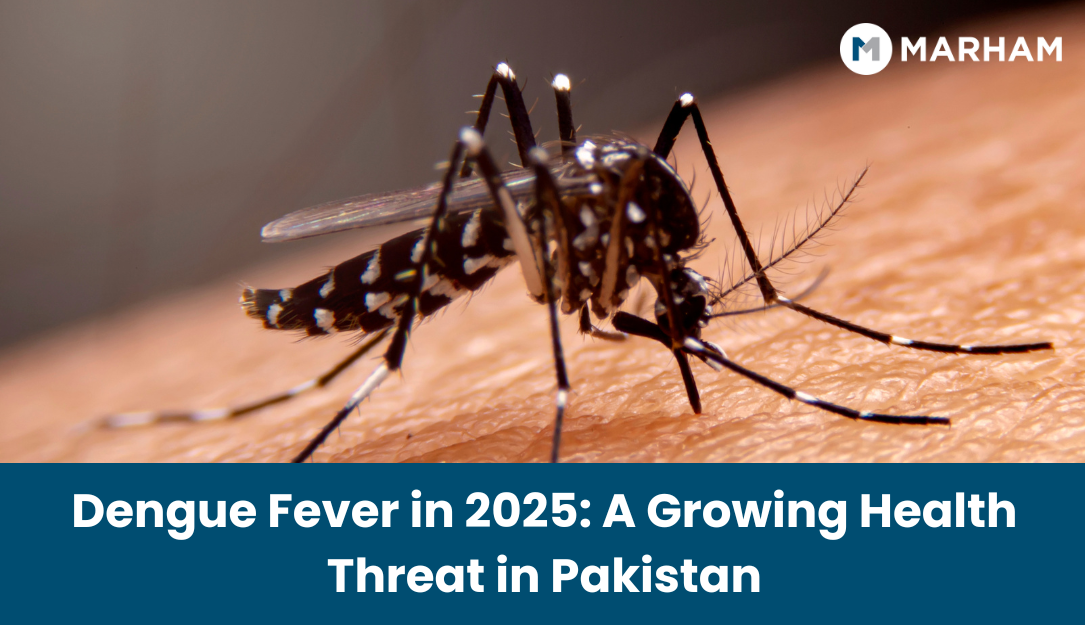
Dengue Fever has become one of the major outbreaks in Pakistan. It affects the health of hundreds of people and, in severe cases, can even lead to death. The health situation in Pakistan is already under pressure due to recent floods, and now dengue is adding to the burden. With stagnant water and poor sanitation creating breeding grounds for mosquitoes.
According to the World Health Organization (WHO), nearly 390 million dengue infections occur every year, and around half of the world’s population is now at risk. In Pakistan alone, seasonal outbreaks are reported annually, and hospitals often become overwhelmed with patients battling this mosquito-borne illness.
Dengue Fever or a Breakbone Fever
Dengue Fever is commonly known as breakbone fever. It causes intense muscular and joint pain. Dengue is a viral infection transmitted by the Aedes aegypti mosquito. The mosquito is most active during early morning and late afternoon.
The bite injects the virus into the bloodstream, which then attacks the immune system. If the early symptoms cannot be managed well, it turns into organ damage. It causes bleeding from orifices and even death.
What Dengue Mosquitoes Actually Do with Your Immune System
Dengue fever is not a congenital disease. It does not spread like the flu from person to person, but it is the virus cycle between humans and mosquitoes. When a dengue mosquito bites an infected person, it carries the virus and passes it to the next person it bites.
Do you ever wonder why dengue outbreaks in Pakistan usually occur at the peak of the monsoon? Dengue is produced in stagnant water such as flowerpots, buckets, open drains, rooftop tanks, and even discarded tires. Even an unnoticed pool of water is enough for hundreds of mosquitoes to breed.

Dengue Fever in Pakistan
According to Memon Medical Institute, as of mid-2025, most dengue cases in Pakistan were reported from Sindh, with a total of 295 cases in the province. Among these, around 260 cases were from Karachi alone, which also registered 32 new cases in June 2025. Sindh also recorded the yearly death toll from dengue.
Dengue was endemic in Pakistan in the past, and seasonal outbreaks, especially during and after the monsoon, with 53,498 reported cases and 95 deaths, were reported between September and December 2019.
Between 1 January and 25 November 2021, four provinces, such as Punjab, Khyber Pakhtunkhwa, Sindh, Balochistan, and the federally administered Islamabad Capital Territory (ICT), and Azad Jammu and Kashmir, Pakistan, have reported 48,906 cases (including 183 deaths (case fatality ratio (CFR): 0.4)).
Punjab province had the highest number of cases of 24,146 and 127 deaths (CFR: 0.5) of 49.4 and 69.4 of all cases and deaths, respectively, as of 25 November. Deaths were only reported mainly in the Lahore district.
Khyber Pakhtunkhwa is a border province with Afghanistan that recorded the second highest number with 10,223 cases, which is 21 percent of the total number of cases, and 10 deaths (CFR: 0.1%).
Sindh province reported 5,548 cases, of which 24 (CFR:0.4) died, and the federally governed ICT with 5,261 cases, of which 21 (CFR: 0.4) died, Balochistan province with 2054 cases, and AJK reported 1674 cases, of which one (CFR:0.1) died.
The rise in cases highlights the ongoing public health challenge dengue poses to Pakistan and the urgent need for early detection, prevention, and treatment.

Why Dengue is Dangerous
According to the National Institute of Health (NIH), dengue outbreaks in Pakistan cause thousands of hospital admissions each year. The danger lies in its unpredictability. Some patients recover within a week, while others deteriorate quickly with sudden bleeding or shock.
Women, children, and people with weak immune systems are at higher risk. What makes dengue even more dangerous is that there is no specific cure. Treatment focuses only on managing symptoms and preventing complications.
What do you feel in Dengue Fever?
The first signs of dengue usually appear 4 to 10 days after a mosquito bite. The symptoms often mimic flu, which is why many people delay medical care, but dengue brings its own distinct warning signs.
Dengue Fever Symptoms:
- Sudden high fever (up to 104°F)
- Severe headache
- Pain behind the eyes
- Muscle and joint pain (breakbone pain)
- Nausea and vomiting
- Skin rash (appears after 2–5 days of fever)
- Fatigue and weakness
In severe cases, symptoms worsen and may include:
- Bleeding gums
- Nosebleeds
- Blood in stool or urine
- Severe abdominal pain
- Difficulty breathing
- Restlessness or confusion
How to Prevent Dengue Fever?
Since there is no vaccine widely available in Pakistan and no specific medicine to cure dengue fever. Only prevention is the most powerful weapon. Small daily habits can reduce the risk for you and your family:
- Eliminate stagnant water: Empty buckets, cover water tanks, and discard old containers where water collects.
- Use mosquito repellents: Apply repellent creams, sprays, or roll-ons when outdoors.
- Wear protective clothing: Full-sleeved shirts and long pants reduce skin exposure.
- Use nets and screens: Sleep under mosquito nets and install mesh screens on windows.
- Keep surroundings clean: Ensure drains and garbage areas near your home are dry and maintained.

Dengue Fever Test
The dengue test is performed to confirm the presence of the dengue virus in the blood. Physicians advised the following test:
Dengue NS1 Antigen Test:
This test detects the dengue virus protein (NS1) during the initial days of infection (typically in the first 5 days). It can particularly be used in early diagnosis.
Dengue IgM/IgG Antibody Tests:
This test identifies the antibodies produced by your body against the virus. IGM antibodies represent a recent infection of dengue, and IgG antibodies represent the previous infection or secondary infection of dengue.
Dengue Fever Treatment
If you suspect dengue, do not rely on self-medication, as it can worsen the condition. Instead, book an appointment with the best general physician in Pakistan, who can help you manage the condition at your earliest convenience. You can also:
- Stay hydrated with plenty of water, ORS, or soups. Dengue causes fluid loss that can lead to shock.
- Rest as much as possible to allow the body to recover.
- Follow prescribed medicines to control fever and pain.
Hospital care may be required in severe cases where intravenous fluids, monitoring, and transfusions become necessary.
The Bottom Line:
Dengue fever is a serious health issue across the world, and Pakistan faces its impact every year with thousands of reported cases. Delays in consultation and treatment can cause severe complications and even death. Dengue is a life-threatening disease, but it can also be a manageable condition with proper diagnosis, medication, and prevention.
In Pakistan, Marham is a medical platform that connects people with the best doctors for online and physical consultations for better treatment. If you or your loved one experiences sudden high fever, severe body pain, or bleeding symptoms, consult a doctor immediately. Early action can save lives.
